Getting Your Pylon Sign Ready Before the Holiday Season
Branding, Digest, Exterior Signage, Metro Sign, Metro Sign & Awning, Others, Signage Tips commercial signage boston,Fluorescent to LED retrofit,LED sign conversion,Metro Sign & Awning,Pylon sign refurbishment,pylon signs,Sign repair and maintenanceIn June, a pylon sign in Greater Boston might not switch on until after 8:00 at night. By Thanksgiving week, it is lit before 4:30 in the afternoon, while stores are still busy and holiday traffic is building.
That is when the problems show up: a dark section where a lamp burned out months ago, a face yellowed by years of sun, lighting so uneven that half the cabinet looks dim. Owners and property managers often catch it on their way out of work, the first week the sign comes on before closing. So does everyone driving past.
Fall is also when many businesses and property teams decide how to use what is left of the year’s budget. A pylon refurbishment or fluorescent-to-LED conversion is one of the few property investments that can be finished before the holidays and noticed by every customer who pulls in.
At Metro Sign & Awning (MSA), requests for this work pick up every fall across Greater Boston and eastern Massachusetts. Here is what it involves, when replacement is the better call, and what an LED conversion can save.
What Shorter Days Reveal About Your Sign
Few things on a commercial property take more of a beating than the pylon at the road. Wind, UV, freeze-thaw cycles, and the salt thrown up by plows and passing traffic all land on it first. After enough New England seasons, wear shows up in predictable places:
- Dark or flickering sections caused by failing fluorescent lamps and ballasts
- Uneven brightness from lamps of different ages, which makes the face look patchy after dark
- Yellowed, faded, or cracked faces that make the brand look older than the business behind it
- Peeling paint, rust, and corrosion on the cabinet, pole covers, and base
- Outdated tenant panels or logos that no longer reflect who is actually on the property
Any one of these is a maintenance item. Together, they tell every driver on the road something about how the property is managed.
What Pylon Sign Refurbishment Includes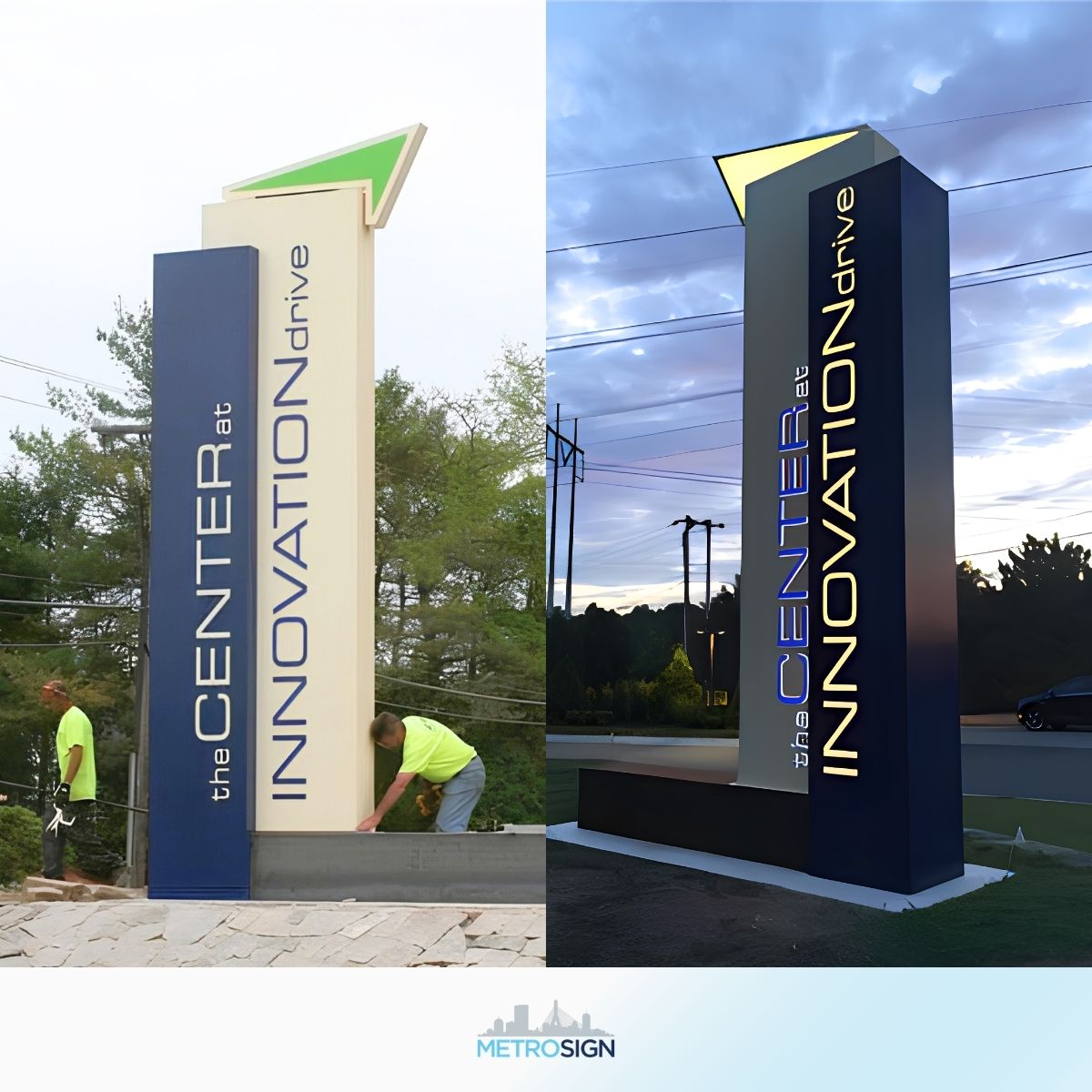
Refurbishment restores an existing sign instead of replacing it, whether or not MSA installed it originally. The foundation, structure, and electrical service stay in place, and those are among the most expensive parts of a new pylon. Depending on condition, a refurbishment can include:
- Cleaning faces, cabinet, and pole covers to remove years of grime and road film
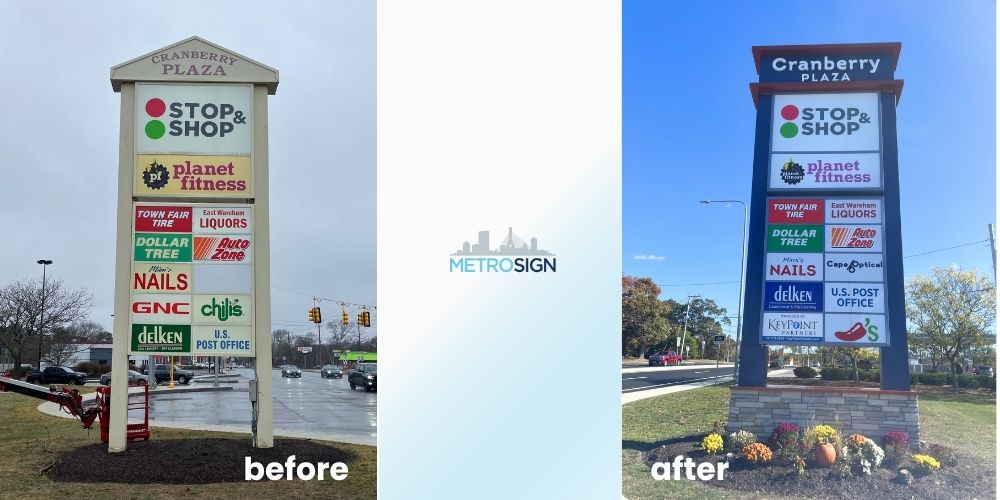
- New faces with updated graphics, corrected brand colors, or revised tenant panels
- Cabinet and pole cover repair, including corrosion treatment and repainting
- Structural inspection of the poles, connections, and base
- Electrical service for wiring, photocells, and timers
- LED conversion of the lighting inside the cabinet
On multi-tenant properties, refurbishment is also the moment to replace a directory patched together through years of turnover with panels in one consistent format. For owners and developers repositioning an older retail property, a refurbished pylon is the most visible signal from the road that the property is being reinvested in.
Refurbish or Replace?
Refurbishment is not the right answer for every sign. It usually makes sense when the structure and foundation are sound, the sign’s size and position still work for the property, and the brand needs a refresh rather than a rebuild.
Replacement is often the better investment when the structure has deteriorated, the cabinet is beyond practical repair, or the property needs a larger sign or a new design direction. Our guide on how to design an eye-catching pylon or monument sign covers what to weigh when a new sign is the right call.
Permitting can tip the decision. Sign rules in many communities have tightened since older pylons went up. Local bylaws frequently allow an existing sign that no longer meets current height, area, or setback limits to be repaired and maintained. They require it to meet today’s rules once it is replaced or substantially altered. In those cases, refurbishment may be what keeps a sign at a size that could not be permitted today.
Where that line falls varies by town, as do requirements for new faces and electrical work. Our overview of regulations and permits for pylon signs covers what Boston-area municipalities typically review. Our permit and zoning research confirms the specifics before we recommend a scope.
Converting Fluorescent Sign Cabinets to LED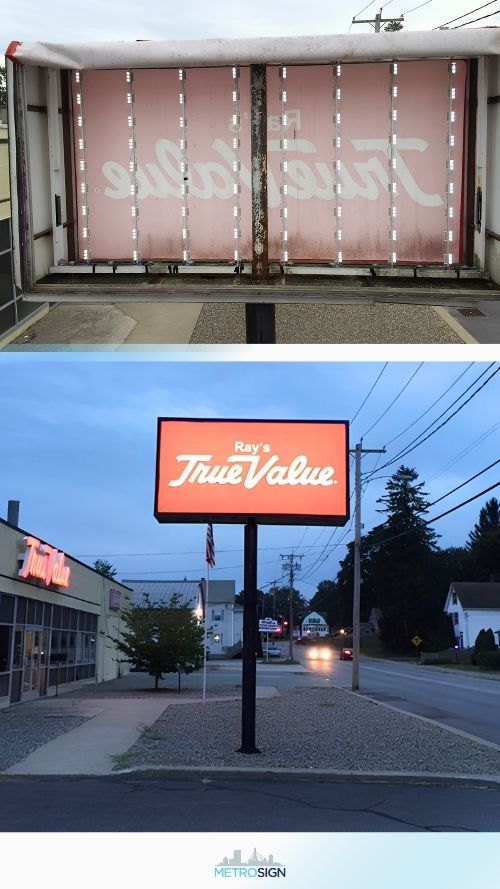
Most older pylon and cabinet signs are still lit by fluorescent lamps and ballasts. In many cases, the lighting can be converted without replacing the cabinet: the lamps and ballasts come out, and LED modules and power supplies go in. On a sound cabinet, it is one of the simplest upgrades a property can make, and the benefits go well beyond the electric bill.
Brighter, more even light. LEDs illuminate the face consistently from edge to edge, without the dim corners and hot spots of aging lamps.
Reliable cold-weather performance. Fluorescent lamps lose output in low temperatures and can be slow to reach full brightness on the coldest nights. LEDs start at full brightness and stay there through a New England winter.
Far less maintenance. LED systems last several times longer than fluorescent lamps, which means fewer service calls, fewer lift truck visits, and fewer weeks with part of the sign dark.
Parts you can still buy. Several New England states have already restricted the sale of fluorescent lamps, and manufacturers keep shifting production to LED. Replacement lamps and ballasts are only getting harder to source.
If you are comparing quotes, ask two questions. Is the retrofit kit listed to UL 879A, the safety standard for LED sign retrofits? And who is performing the electrical work? The answers separate a conversion built to last from one built to be cheap.
Running the Numbers on an LED Conversion
Savings depend on cabinet size, the lamps inside, and operating hours, but the math is straightforward. Here is an illustrative example for a double-sided pylon cabinet:
- Current fluorescent lighting: about 1,200 watts
- After LED conversion: about 450 watts
- Hours lit, dusk to dawn: about 4,400 per year
- Electricity rate: 24 cents per kilowatt-hour, close to recent Massachusetts commercial averages
- Result: roughly 3,300 fewer kilowatt-hours and about $790 saved per year
That is electricity alone, on a single sign. Fewer lamp, ballast, and service costs add to the return, and the savings multiply across multiple pylons or locations.
To run your own numbers: (current watts minus LED watts) × annual hours ÷ 1,000 × your electricity rate. MSA can confirm the wattage for your sign during an assessment.
Why Timing Matters Before Black Friday
Clocks fall back the first Sunday in November, and Black Friday follows about four weeks later. From then on, your pylon does its most important work during the busiest shopping weeks of the year, much of it after dark.
Projects that start in early fall have the most room to move through assessment, permitting, and fabrication before installation. As November approaches, installation calendars fill and the weather window for exterior work narrows. Starting now also puts a real number against remaining year-end budget. The alternative is pushing the project into next year and running a dim sign through the holidays.
How MSA Handles Refurbishment and LED Conversions
- Site assessment. We inspect the structure, cabinet, faces, and electrical components, and document what can be restored.
- Clear recommendation. Refurbish, convert, both, or replace, with the reasoning behind it.
- Permitting. We confirm what your municipality requires and handle the applications.
- Fabrication. New faces, panels, and components are produced in our Tewksbury shop.
- Installation. Our crews complete the work with minimal disruption to the property and its tenants.
See examples in our fabrication, installation, and service portfolio. Once your sign is back in shape, our repair and maintenance services keep it that way with scheduled inspections and cleaning.
Why Property Owners Across Greater Boston Work with Metro Sign & Awning
Because MSA designs, builds, and services pylons, our recommendation starts with the sign you already have. When a refurbishment will deliver years of reliable performance, that is what we recommend. When replacement is the smarter investment, we show you why, and we handle the new sign from design and permitting through installation.
Is your pylon sign ready for the holiday season?
Talk to Metro Sign & Awning about a refurbishment assessment or LED conversion. We will evaluate your sign, recommend the right scope, and help you plan the work around your holiday timeline.